Showing posts with label Art. Show all posts

Thursday, 24 February 2011

She One

Last year I interviewed the artist She One. Here are the results. Note that I do not own the copyright to the images so if you are the copyright holder and wish for them to be removed then please let me know.

She One

London artist She One is pretty clear about his role in the art world. “I’m a Graffiti artist.” He states bluntly. This is not strictly true. To say She One is a Graffiti artist is like saying Jackson Pollock used to throw a bit of paint on the canvas. Both statements are partially accurate but give no genuine indication how great each of the respective artists work is.

She One’s huge paintings push the notion of what can be considered Graffiti to its limits. To the casual observer his pieces seem to have more in common with Abstract Expressionist painting than the kind of Graffiti we see thrown up by train lines or daubed as tags across the country.

I first came across the work of She One in the ground breaking 1998 street art compendium Scrawl, Dirty Graphics and Strange Characters. Of all the awe inspiring art in the book it was the work of She One that captured mine and many other’s imaginations. This was pretty out there stuff, even in a book featuring legendary New York Graffiti oddball and bona fide legend, Futura 2000. Somehow, She One managed to make some luminaries of the scene look decidedly pedestrian.

A key text in the history of graffiti was the 1984 book Subway Art by photographer Henry Chalfant. The book chronicled the early days of New York Graffiti, and along with classic Graff movies Wild Style and Style Wars countless kids were inspired  to pick up a spray can and take to their nearest drab city centre and put some colour into in the grey and decaying town centres of eighties Britain. She One was one of those kids.

“My work is deeply rooted in the New York Subway graffiti era circa 78' - 82, in particular
a group of artists called The Death Squad who were at the forefront of taking art from the
trains and translating it onto canvas.” He says. The Death Squad was a crew that cared more about pushing the envelope stylistically than ritualistically tagging every blank surface going. The Death Squad pioneered challenging and innovative new typography and lettering, developing a signature style that was more out there and complex than any of their predecessors in the New York and Global Graffiti scenes.

So deep rooted is this New York influence in She One’s work that you really have to train your eyes to make out the traditional Graffiti and typographical elements in the paintings. At first they seem like a series of minimal, violent streaks of spray paint on the canvas which form spidery abstract patterns. But look into the painting, and consider the title of the piece and the letterforms may suddenly become clear. Like a Graffiti magic eye picture.
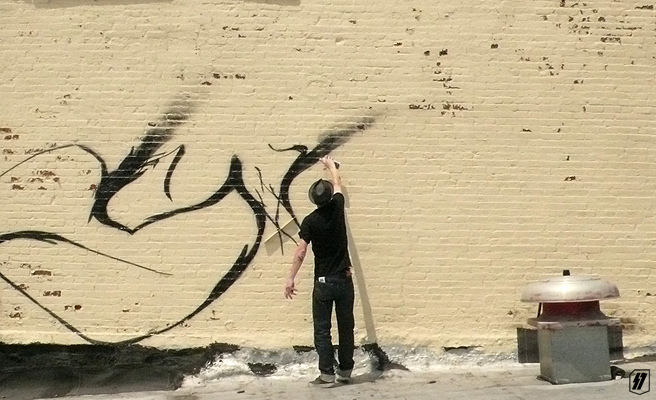

Other than being inspired by the heritage and origins of the original Graffiti birth place, New York City, She One claims that “As for influence, there is nothing concrete; I just paint what I feel.”  It is in fact, the titles of the paintings which are of the most important creative decisions She One makes when beginning new work. “In the studio I work paintings up from drawing” He says, “I will essentially design a set of paintings before I start them, the feel, the direction of the paint and the titles. The titles are very important as they inform the content.”

Both She One’s studio and live work can seem slapdash and chaotic given the rapid speed at which he paints and the vast broad streaks of paint which criss-crossing the canvas, yet the brush and can strokes are carefully applied and meticulously orchestrated. They are an accumulation of over ten years of She One honing his unique style. “I definitely didn't just 'hit upon' my style of painting; it is purely the result of drawing typography and executing paintings with spray paint.” He tells me.

When painting live for a club night or event, She One paints straight onto whatever surface is in front of him with no planning. He feeds off the urgency and spontaneity that painting live in front of an audience demands. “It’s like doing a 20 minute guitar solo, where once you start you don’t know where it’s going to end. You have to go with it and commit to that moment.”

This takes me a little by surprise, that for an artist whose work is characteristically lean, he compares himself to such a bloated and self indulgent act as the extended guitar solo. But shake off the Spinal Tap associations and the comparison makes sense, it is improvisation and virtuosity which informs the work he creates. He is often totally surprised by the outcome of the live painting to the point of feeling overwhelmed when viewing the work after leaving the trance-like plain he inhabits when creating it.


Many of She One’s Scrawl peers were art school educated. Mr Jago trained as a graphic designer while others like Will Barras worked in illustration and Animation but She One has no formal training. “I have never been to art school, however as a teenager I was fortunate to discover spray paint as a medium.” He says. “Fortunate because spray paint and the application of graffiti had no legitimate artistic legacy and so I was free from any pre conceived critique of my approach to image making.” He adds.

It is this lack of legitimate artistic legacy that has led many in the street art and Graffiti community to be open about the prospect of commodifying their work. While many fine artists would rather starve than sell their work to clothing companies and toy manufacturers, Graff artists have never been so precious.

The artists of the Scrawl generation realised that through collaboration with commercial outlets more people would get to see their work and they would have a legitimate opportunity to make a decent living doing what they love. And the icing on the cake was that through choosing to work with companies and organisations which were sympathetic to their aesthetic they could maintain a great deal of creative autonomy.

This mix of commerce and creativity seems perfectly natural to She One. “All art is commerce or we wouldn’t have any galleries.” He Says, “Graffiti artists in particular have been good at commodifying their aesthetic into low priced collectibles. The art world has really caught up and contemporary gallery and museum shops are bulging with art licensed onto everyday objects.”

One of She One’s most enduring collaborations was his work for the Addict clothing brand which has seen his designs sported by thousands of people worldwide.  “Addict gave me the opportunity to create a fabric pattern, the S1 Camo, initially it was going to be for one jacket but it is still in production on clothing and products five years later.” He says.

There is no denying that seeing your work on people in the street must be a buzz to rival seeing one of your pieces on a wall or train. It’s something that is not lost on She One. He confesses, “Wherever I travel in the world I see people wearing it. It is a genuinely humbling feeling to have created something that has resonated with such a diverse audience.”

But does he feel that he has had to compromise his artistic vision in undertaking this type of collaboration? “I will explore any avenue of application of my works as long as I feel it is sympathetic to my overall body of work.” He says.


So, I ask, what do you have planned for your work in the near future? He answers as if this were the most unoriginal question in the world (which it indeed may be) and he clearly doesn’t feel the need to offer an elaborate answer, “Colour, slogans, coffee and cigarettes.”

The brevity of his answers seems largely due to being bored of being asked the same old questions (he confirms this to me in a later email). I can’t help think it is inevitable that numerous journalists would pursue the same lines of enquiry given he has maintained the same striking visual aesthetic for over a decade now.
He has never deviated dramatically from his style of painting, he has simply evolved his initial vision, stretching it across the canvas until it has no where left to go then stretching it some more until it spills over and takes on a new identity, becoming its own new piece. He has innovated in style, but not in form.

She One is like a scientist in his lab testing a formula. He works to balance all the elements within a painting; the colour, the dimensions, the textures. He repeats the things that worked previously and eliminates those that have failed with the hope of one day presenting a perfect distillation of his aesthetic. Whether he will ever achieve the perfect alchemy will remain to be seen, but for the rest of us, it will be fun watching him try.

Tuesday, 3 August 2010

'100 Faces, 100 Stories'- Participation & Inclusion in Community Arts

I recently collaborated on a new Art Project tackling perceptions of homelessness at the charity Crisis' Newcastle resource centre. I wrote this article about the project and some of the issues faced by participatory arts projects in general.


Listening to Alan Lyddiard talk about his new arts project ‘100 Faces, 100 stories’ can be both a frustrating and enlightening experience. Such is his passion for the arts in all its myriads of forms, Alan can have a tendency to go a little; shall we say, off topic? He often goes off on wild tangents, telling meandering tales of his experiences and influences often all in the same sentence.

Alan made his name as a theatre director, specialising in George Orwell adaptations. He has extensively toured his own particular renderings of Down and Out in Paris and London, 1984 and Animal Farm, playing to audiences worldwide to considerable acclaim.

Alan is pretty much everything you would want, or maybe expect, in a theatre director. He’s enthusiastic, passionate, manic, camp as Christmas and a man with a genuine empathy for presenting authentic voices in art.

It is this search for authentic voices which gave Alan the idea for ‘100 Faces, 100 Stories.’ Alan is to oversee the production of an installation at the Crisis Skylight centre at City House in Newcastle. The installation will feature 100 stories and 100 complementing images all exploring themes of destitution, vulnerability and homelessness.

The stories are to be gathered through collaboration between service users of Crisis Skylight, which is a resource and education centre for homeless or vulnerably housed people, and a number of the regions writers as well as artists and photographers. Writing sessions will take place at formal workshops but there is also a strong sense of autonomy in regards to what work the writers choose to submit. 

Writers may craft work which is based on their own experiences, of the experiences they have seen around them. Some accounts may be fictional, others anecdotal. The writers will also try to document the experiences of those who use Crisis Skylight, including those service users for whom not having a secure place to stay, is a daily reality

There are few boundaries for the project and it will encompass sculpture, performance and other mixed media art. In short, ‘100 Faces, 100 Stories’ will be a melting pot of ideas and a beautiful mix of style, thoughts, cultures and techniques. 

“I wanted to get writers involved either to write stories or to help them the service users to write their stories or to act as a kind of mentor.”Alan Said. He hopes the project will work as a conduit to give an artistic voice to those who are marginalised. On his motivation to create the work, he said, “We want to focus on the idea of empathy and to see the world through other people’s eyes.” He added, “I want to get under the skin of these people who are vulnerable and I want to see into the soul of these people.”

When Alan speaks about ‘100 Faces, 100 Stories’, Alan often sets off on ebullient flights of fancy. On paper there is much that would make Alan sound very much the rambling pseud. I must admit, when he makes airy proclamations such as, “I like the idea of putting pieces of paper on walls. I think there is something quite religious in that. You see it quite often in Eastern Europe,” It’s hard not to chuckle at the absent minded artistic posturing.

But, catch Alan in full flow and it is hard not to be swept up in his excitable stream of consciousness visualising. He is also nothing if not ambitious; he predicts that ‘100 Faces, 100 Stories’ will be “Just the beginning of something special.” Alan hopes to take some of the experiences and results of the project and incorporate it into his theatre work and then, taking it global.
Project Leader- Alan Lyddiard

“The next stage is using these stories and people with difficulties in their lives and professional actors and making a play about it. I would like it to be a kind of contemporary Down and Out in Paris and London” He said, adding, “I want to take it to cities all over the world such as Manila which is the poorest city I have ever been to.”

For the meantime though, the project is very much rooted in the North East. It is the Crisis Skylight centre which is to house the installation and provide much of its initial inspiration. The Newcastle centre was opened in 2007 by the national charity for single homeless people, Crisis. The centre was the first Crisis opened outside of London and provides education and training to help homeless people gain employment, as well as offering a range of classes focussed around well being such as yoga, meditation and creative writing. The centres act to allow service users to learn the skills to help themselves.

Crisis are keen to point out that there is a much bigger picture to consider in regards to issues of homelessness. They are keen to dismiss the common assumption that you must sleep on the streets to be considered homeless.

The Crisis website states, “Homelessness is about more than rooflessness. A home is not just a physical space, it also has a legal and social dimension. A home provides roots, identity, a sense of belonging and a place of emotional wellbeing. Homelessness is about the loss of these.”

Homelessness remains is a major social issue and there are some pretty shocking statistics related to this ‘bigger picture’ view of homeless. For every one rough sleeper in this country, there are roughly 100 people living in hostels, and approximately 1100 people living in unsecure or overcrowded accommodation.
Based on figures collected by the Department for Communities and Local Government for England in 2007, There are approximately 500 people in England sleeping rough each night, 50,000 staying in hostel accommodation and just over half a million people living in cramped and vulnerable conditions. Despite these estimations at the time those figures were collated, only 84,900 of these overcrowded or vulnerable households were classified as homeless. There is a very clear disparity in these figures, and in how hopelessness is perceived in general.

While the ‘100 Faces, 100 Stories’ project certainly hopes to allow the voices and experiences of those affected by homelessness to be shared, Alan Lyddiard has a different focus for the project. Alan sees homelessness as a worthy subject to make art about but his priority is to create a competent, accomplished and engaging work of art over any social agenda.

“What I want to find out”, he said, “is can we create great art with everybody? Some artists think there is amateur art and professional art. I want to go beyond that. I think we can create great art, working class art, with a small group of people.”

I find Alan’s intentions and honesty refreshing. Many in the community focused arts world would choose to focus on the ‘worthy’ angle for a project like this but Alan clearly has a lot of belief in the people involved in the project, and also in people in general, as well as high expectations. Regardless of Alan’s motivation for driving this project, the desire to create inclusive, participatory art can reap huge emotional and psychological rewards for those service users and artists involved.  

In 2008, Arts Council England published the paper ‘Great Art, Good Intentions’ the paper aimed to address some of the stigmas and limitations within the field of participatory arts. The intended outcome was that by 2011 the Arts Council would support arts organisations “To overcome barriers to engagement and participation in the arts, focussing in particular on reaching those who at present rarely or never attend or take part in the arts.”

Those involved in the arts have a lot of responsibility in maintaining the balancing act between social inclusiveness and creating high quality art. They must at once create a high value aesthetic, which is seen as valid to other artists, the public, funders and other organisations while delivering positive social and community relevant outcomes.

The Arts Council believe there is much value in participatory art practices, stating in the ‘Great Art’ paper, “It is a malleable dialogue that informs the work of the artist, builds and develops audiences, engages with communities, promotes learning and forges routes into active experience and artistic creation of many kinds.” Alan Lyddiard supports the views of the Arts Council. He said, “I want to go for great art but I want good intentions to be integral to that.”  

Writer Tim Joss ruffled the feathers of many in the profession with the publication of his book ‘New Flow: A Better Future for Artists, Citizens and State’ in 2008. Joss was deeply critical of the existing models of, participatory arts practice in England.

In ‘New Flow’ he said, “A public debate grinds on about the value of the arts in society. It has set up a misleading polarity between the arts intrinsic and instrumental benefits.” ‘New Flow’ called for a reform in the participatory arts to create a comfortable space where creativity meets inclusion. This public scepticism of the value of the arts is something Joss believes must change.

Alan Johnson, Secretary of State for Health agrees, “I would like to see the benefits of participation in the arts recognised more widely by health and social care professionals.” he said, adding, “Access and participation in the arts are an essential part of everyday well being and quality of life.”
In these collaborative, creative environments the skill of the professional artists combine with the creative energy of the participants to create that “something special” Alan had foreseen with his project. The outcome of such processes is that all involved quickly become more than the sum of their parts.

This improvement to well being is one of the most simple benefits of taking part in participatory art. In a 1997 study, Francois Matarosso identified over 50 different positive outcomes from participation in the arts. It can bring us pleasure, it can relieve stress and it can be deeply cathartic.

I hoped to feel some of these benefits when I decided to contribute to the ‘100 Faces, 100 Stories’ project and get involved first hand. I headed down to one of the weekly writers workshops down at Crisis Skylight in Newcastle City centre. The workshops are an opportunity for writers to get feedback on the stories they have collected and written, as well as an opportunity to catch up on the progress of the project as a whole. The latter is an incredibly important element of the workshops as I found out. Alan’s vision of what he wants to achieve from ‘100 Faces, 100 Stories’ is constantly evolving, sometimes so quickly it’s hard to keep up.

At the workshops I was witness to some really great work being moulded and formed. I saw the beginnings of some beautiful complex sculptures featuring themes of ornithology, disease and renewal. The piece featured taxidermy merged with medical apparatus to create an unnerving amalgamation of the natural and the artificial coming together with an eerie disharmony.

I also had the opportunity to hear some of the stories which have been compiled for ‘100 Faces, 100 Stories.’ Many of the stories were written by the service users of Crisis Skylight themselves. Some of the stories were light-hearted tales of happier times, of childhood and family. Others tread a much darker, more contemplative path. Alan showed us a video of one service user telling his story where he admitted to trying to kill his mother in a drunken rage.

Another story detailed a young man’s experiences battling mental health taking in destitution, incarceration and attempted suicide. Many of the stories were deeply sad but many of the protagonists are now able to focus their lives towards positive goals. I still couldn’t help but feel a sense of melancholy when hearing the stories as they were so short in length (around 500 words each) we were always left with a sense of ambiguity in regards to the fate of those in the stories resulting in a great sense of pathos.

In order to write my own story for ‘100 Faces, 100 Stories’ I decided to spend some time at the Crisis Skylight Cafe. The Cafe is a commercially run cafe which is open to the public but employs homeless people to work there. The cafe is an excellent opportunity for those affected by homelessness to learn new, practical skills while earning money and gaining recognised qualifications.

Unfortunately, on my trip to the Crisis Skylight cafe, it was totally rammed. All my attempts to talk to the staff about their experiences were quickly aborted due to the constant flow of customers. So, sat enjoying a fair trade coffee, I thought about my own experiences and preconceptions of homelessness.

Four years ago I spent just under a year drifting from floor to sofa in a number of flats and houses in Manchester. It was a pretty uncomfortable existence. I was unemployed for much of it, penniless but glad to have a roof over my head. Since that time I had blocked this ‘wilderness year’ out of my mind having found a job and somewhere stable to live. Strangely though I never thought of myself as homeless, but then maybe that’s because I had other options, friends and family I could rely on. Perhaps I have a preconceived (and totally erroneous) notion of what a homeless person is like. Looking over the Crisis statistics on homelessness, it dawned on me that I had been one of these statistics. Slowly but surely memories began to surface of my experiences around that time. One particular memory came to mind, so I put pen to paper, Alan Lyddiard’s words echoing round my head, “Everyone has a story to tell.”

The story I wrote was detailed a time when I was sleeping on the floor of a small, damp living room in a rundown flat in a trendy bit of South Manchester. One morning I awoke to find slug trails latticing my pillow centimetres away from my face. After a failed attempt of sleeping within a circle of salt, I decided to take more drastic action. I procured some slug pellets and began liberally dousing them around the backyard where I believed the creepy gastropods were getting into the house from. I woke after an anxious night and checked my pillow. There were no slimy trails. I headed to the yard where I was met with the repulsive sight of approximately 3000 dead slugs. Horrified I checked the empty carton of pellets. The tub informed me the pellets attracted slugs and then poisoned them. I had failed to read the instructions on the back which read ‘“Use one kilogram tub per 44,000 sq feet.”

Whilst on the surface simple being a funny, if fairly unsettling story, I found the process of writing about that time cathartic. Storytelling has always been used to reflect on our experiences and make sense of our surroundings. Allan et al, in a 2002 essay about the benefits of storytelling, said, “Stories encourage creativity, help in handling emotion and help to make sense of puzzling situations.”

The value of storytelling is often neglected in the world of participatory arts. There is often a clash between what is considered timeless or classic in art versus the contemporaneous view that art, including storytelling can have a valid and beneficial social purpose.

Stories have been a community activity since the beginning of time, from when there was no other means to pass on information and histories other than to do it orally. In this tradition of community storytelling, stories are didactic tools. They have a moral or a meaning. They say, “Learn from my mistakes.”

The ‘100 Faces, 100 Stories’ project will hopefully use these incredible, rich stories as a catalyst for learning resulting in people challenging their preconceived ideas of what homelessness is. In his book ‘Storytelling in Organizations: Facts, Fictions, and Fantasies,’ Yainnis Gabriel said, “Storytelling is an art of weaving, of constructing the product of intimate knowledge.”

With this in mind, the sheer scale of the ‘100 Faces 100 Stories’ should provide a vastly educational and enlightening experience for anyone who has the pleasure to view it.

‘100 Faces, 100 Stories’ will take place in the courtyard of Crisis Skylight, 1 City Road, Newcastle on 9th, 10th and 11th September 2010


Photographs by Magali Pettier for Small Change magazine


There is a shorter, additional article on ‘100 Faces, 100 Stories’ by Ben O’Connell in the Summer 2010 issue of Small Change magazine.

Monday, 2 August 2010

Where Did You Sleep Last Night? Crisis Skylight Story

I recently did some work with the homeless charity Crisis Skylight in Newcastle. I was part of a writer’s workshop, working with service users at the centre to write 100 stories about homelessness and to capture their experiences of destitution and combine them with 100 portrait photographs of those who have contributed. I also wrote an article on the project and storytelling and participatory arts in general which I will also post along with some of the portraits.

This is the story I have contributed: Where Did You Sleep Last Night?

Walking into the kitchen for the first time I noticed someone had just been to the supermarket. Every surface was swamped by bulging Morrison’s carrier bags. It was only on closer inspection I realised all of the bags were full of rubbish due to the resident’s reluctance to empty the main bin which itself was spewing out debris like a grotty fountain. With no money, no job and nowhere to stay I had been rescued from a looming nervous breakdown by three kindly friends who said I could sleep on their living room floor. Unfortunately for me, the boys were not the most house proud of fellows.       

One morning I woke to find my pillow covered in threads of silky sticky dew. On closer inspection I found that slugs had got in under the kitchen door and made a steady somnolent pilgrimage towards my cosy pillow. I felt pretty disgusted to say the least. I began to sleep within a ring of salt in order to keep any wayward molluscs at bay. I felt particularly pleased with my ingenious solution to this problem until one night I woke up to see a dozen slimy gastropods hovering around the perimeters of the salty fence I had erected.                     

Skin crawling I vowed to take more serious action against my tormentors. I headed to Woolworths and bought a large tub of slug pellets. Returning home I set about dusting the yard with said pellets. I felt a bit like an olden-days farmer sowing the seeds of his crop. I suspect the reality of the situation was that I looked like the star of a camp, albeit, murderous Shake n’ Vac advert. That night I felt wary sleeping without my sodium moat. I convinced myself that the pellets would present enough of a barrier for the slugs and eventually I fell asleep.                  

When I awoke I checked my pillow for silky trails. It was clear bar a small wet patch from where I had been sleeping open-mouthed. I inspected the kitchen (also clear) then ventured into the yard. Very little could have prepared me for what assaulted my eyes. Looking out across the 6ft square yard I saw approximately 3,000 shrivelled up, very, very dead slugs. Filled with guilt and Horror, I grabbed the empty tub of pellets that I had discarded in the kitchen. My eyes darting across the words on the packaging, I found the bit that says ‘instructions for use’ they said; “This product works by attracting slugs to the pellets, drawing them away from plants and crops then eradicating the slug by means of poisoning.” The packaging also went on to say, “Use one kilogram tub per 44,000 sq feet.”

Copyright Mark Dawson 2010

Small Change Magazine

It has been a long long time since I've updated my blog. One reason was that I lost everything on my hard drive including 5 or 6 articles I had written. Hopefully I will get them written up again and on here soon.
The second reason is that I have been tied up with finishing the first Issue of new free North East culture magazine, Small Change.

We have distributed nearly 3000 complimentary copies of Small Change around the North East so be on the look out for it in a bar/gallery/knocking shop near you. It's wonderful. It was designed by the incredibly talented Mickey Devine (www.mickeydevine.com) and edited by yours truly and Colin Young alongside the Sunderland University MA journalism students. If you would like a copy send me a mail on mark@smallchangepublishing.co.uk


The launch was at Plugged Inn, Sunderland and the guys there were most welcoming and helpful. I'd recomend it for a do or a even just a quite pint.
Issue one features pieces on the Bobby Robson Foundation, Sunderland Youth Music Workshops, Middlesbrough Music Live, Urban Exploration, Stockton Globe Theatre and much much more.


Small Change publishing will be looking at producing issue two of Small Change come September, as well as another new Arts magazine venture called Don't Hate focussing on innovation in the arts. Keep your eyes peeled.

Monday, 25 January 2010

Mementos and Memories: An Online Art Project

Dragging the box out from the shed, I’m hit by a musty waft of nostalgia as a vague, familiar smell leaks from it.

Later I examine the boxes contents. Among old books, records and pin badges is a torn blue paper folder. Spilling from it are piles of notebooks and scrappy bits of paper covered in manic scribbles.

The folder contains mix tapes, made by girlfriends past, Photographs of the women I had loved many years ago, leaflets for the exhibitions we went to.

Looking through this archive of my thoughts, feelings, mistakes and triumphs makes me feel both elated and forlorn.

I teeter vicariously between laughter and tears throughout the experience of sifting through over 10 years of personal history.

The reason for this foray into my past is because I have agreed to contribute to University of Sunderland student Michelle Wall’s ‘Mementos and Memories’ art project.

Michelle hopes to exhibit the treasured and everyday items we hide away in our homes which remind us of a special memory or experience.

The inspiration for the project comes from Michelle finding an ornate suitcase in her loft. The suitcase belonged to the houses previous tenants, who had lived there for three generations.

It contained bundles of correspondence between a married couple forced to live apart during the 1940’s and 50’s. Unable to see each other they shared their lives together on paper.

“The fact these letters had been kept, treasured and survived all that time was inspiring to me,” Michelle said. “I wanted to celebrate this as a legacy to their relationship by exploring the treasured memories of others.” She says of her inspiration for the project.

Michelle, who is in the final year of her fine art degree, initialised the project by collecting and displaying her own mementos. Hers were memories of adolescence and early relationships through to recent marriage and motherhood.

She has now begun collecting the mementos of others with the aim of putting together a exhibition and book that will become a collective memento of its own because, she said, “I want us all to acknowledge and appreciate the otherwise fleeting and forgotten moments in our past.”

On the things Michelle is most interested in is the way these items are stored. “These keepsakes are often tucked away, they are too precious or personal to display,” she told me.

“To anyone else a ticket stub or a melted candle would mean nothing. Yet given its history and connection to its owner it takes on a new identity.”

The memory then begins to transcend the realm of the mind. It is transformed into a tangible, physical thing, what Michelle describes as “a vessel of sentiment.”

This is why I find myself sifting through my own mementos and memories. Reading through my old notebooks it strikes me, for better or worse, how much I’ve changed and the ways in which I’ve stayed the same.

All the bittersweet experiences of life are documented in the yellowing pages. I am thankful to Michelle for dredging it all up. I can only suggest you do the same as it was horrible and wonderful.